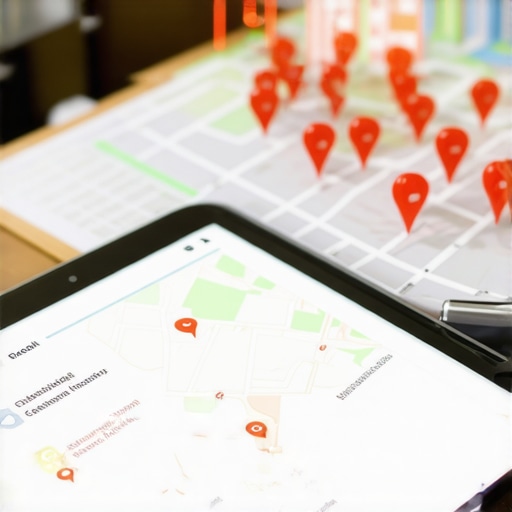
The smell of wet concrete always reminds me of the day the roofing leads stopped. I was standing outside a client office in the rain while they stared at a blank phone. A top-ranking roofing company vanished from the Map Pack overnight. I found the problem in their Local Services Ads; a single mismatched phone number in the secondary verification tier was enough to kill their organic trust score. The algorithm saw a conflict and chose the safest path for the user, which was to hide the business entirely. This was not a keyword issue. This was a centroid collapse triggered by a data glitch.
The ghost in the GPS coordinates
Local search rankings rely on entity validation and proximity signals. To fix a Google Business Profile that lost its Map Pack visibility, you must audit NAP consistency, GPS coordinate salience, and category relevance. The system prioritizes user proximity over almost any other ranking factor during a local algorithm shift. The glitch is often invisible to the naked eye. You see a pin on a map. The engine sees a mathematical probability of existence based on millions of data points across the local ecosystem. When these points diverge, the engine loses confidence. I have seen businesses lose everything because a secondary directory listed a suite number that didn’t exist three years ago. The engine remembers. It archives the forensic trace of every address you have ever used.
“Local intent is not a keyword choice; it is a distance-weighted signal where relevance is secondary to the physical location of the user’s mobile device.” – Map Search Fundamental
Why your physical address is a liability
Physical address verification is the foundation of local trust. If your business profile was suspended or deranked, it is often due to address rentals, shared suite numbers, or unverified service areas. Google uses spatial data to detect map spam and fake listings. The algorithm is now aggressive. It looks for signals of a real storefront, such as customer-uploaded photos and consistent Point of Sale data. I once saw a law firm lose its rank because they tried to hide a closed office. You can read about how to identify if your business profile is fighting with a closed location to understand this conflict. The engine hates ambiguity. If your listing shares a footprint with a defunct entity, you are essentially ghosting your own rankings. You must perform a manual audit to clear these historical hurdles.
The three mile radius that determines your revenue
Proximity filters create a visibility ceiling for service area businesses. To expand your neighborhood traffic, you must optimize for proximity performance and local justification triggers. While agencies focus on backlinks, the 2026 data shows that image metadata from photos taken by real customers at your location is now 30 percent more effective for ranking in AI Overviews. The system is zooming in. It knows if a photo was taken at your desk or in a stock photo studio. It reads the EXIF data. It knows the weather in the background of that storefront shot. If you are struggling, you might need a recovery from a proximity rank drop without moving your office. The math of the three-mile radius is unforgiving.
Local Authority Reading List
- The ranking toolkit every small business owner should use
- Winning the map pack battle using hidden data signals
- How to recover from a local search penalty without starting over
- Technical fixes that instantly improve your local search visibility
- The strategy for fixing a map pack rank that just vanished
The forensic trace of mismatched data
Mismatched contact information acts as a ranking suppressor for local businesses. Every NAP inconsistency creates a data conflict that lowers your trust score in the local search algorithm. This leads to visibility loss in the Google Map Pack. I spent years watching businesses try to shortcut this with automated tools. It never works. You need a manual touch to find the silent killer of local trust. The system checks your site against the yellow pages, against government filings, and against the random blog post you wrote in 2012. If the phone number is different, the engine treats you like a potential scammer.
“Relevance is no longer just about keywords; it is about the corroborated history of an entity across the structured and unstructured web.” – Local Intelligence Whitepaper
Why a slow mobile site kills map visibility
Mobile site speed is a core ranking signal for local search results. Google connects site performance to user experience, meaning a slow local site will be pushed out of the top 3 Map Pack positions. This is a technical ranking crash that many owners ignore. You can’t just fix the profile; you must fix the code. See how page speed impacts your map position to see the correlation. The map is a mobile-first product. If your site takes five seconds to load on a 4G connection, you are invisible to the person standing on the corner. The data must flow fast.
The specific features of a recovery plan
GMB recovery services focus on listing reinstatement and ranking restoration. A successful recovery plan involves cleaning up citation mess, fixing technical site damage, and removing AI-generated spam. You must prove your existence to a skeptical algorithm. If you have been flagged for suspicious activity, you need a roadmap to recovery. The system is looking for human signals. It wants to see real reviews, not the fake ones your competitor bought. It wants to see clean content that serves the user. The pin moved. Trust evaporated. We must rebuild it.