The One Audit Step That Finally Fixed Our Google Maps Visibility
It is the ultimate frustration for any local business owner: You have a beautiful website, hundreds of five-star reviews, and a service that blows the competition out of the water, yet the phone remains silent. You search for your services on Google, and while your competitors – some with fewer reviews and worse websites – are sitting comfortably in the Local 3-Pack, your business is nowhere to be found. You’ve checked the boxes, filled out the descriptions, and uploaded the photos, but you are effectively invisible.
My name is Kevin Pauls. As a Local SEO Consultant and Google Business Profile Product Expert, I have spent years diagnosing why high-quality businesses fail to rank. The hard truth is that most standard SEO audits only look at the profile in a vacuum. They check if the phone number is correct or if the “About” section is filled out. But Google doesn’t rank businesses in a vacuum; it ranks them in a physical, geographic reality. The “One Step” that finally fixed our visibility – and can fix yours – is the GeoGrid Visibility Audit. This isn’t just about checking a list; it’s about visualizing the map exactly how Google sees it.
Why Standard Google Business Profile Audits Fail
If you hire a traditional marketing agency, they will likely provide you with a checklist audit. They’ll tell you that your NAP (Name, Address, Phone) is consistent and that you’ve used all 750 characters of your business description. While these are necessary foundations, they are rarely the reason a business is stuck on page four of the map results. These audits fail because they treat 3 Common Mistakes Quietly Killing Your Local Search Visibility as minor clerical errors rather than structural algorithm failures.
Google’s local algorithm is built on three pillars: Relevance, Distance, and Prominence. Standard audits focus almost entirely on relevance and prominence while completely ignoring the most volatile factor: Distance. We are entering an era where Google’s “Ask Maps” AI feature uses your profile data to answer complex natural language queries. If your audit doesn’t account for how your data is perceived across different micro-locations, you are flying blind. A standard audit tells you what you have; a GeoGrid audit tells you where you are actually winning and losing.
The Game-Changer: The GeoGrid Visibility Audit
The “One Step” that changed everything for our clients was moving away from single-point rank tracking. Traditional rank trackers tell you that you rank #2 for “Plumber in Chicago.” But Chicago is 234 square miles. You might rank #2 if someone searches from the coffee shop next to your office, but what about the homeowner five miles south? Or the business district three miles north?
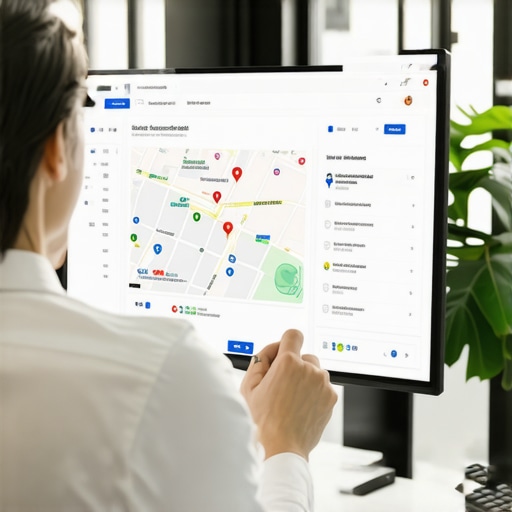
A GeoGrid Visibility Audit uses a google maps rank tracker to plot your rankings across a multi-point geographic grid. Imagine a map of your city with a 13×13 grid of dots overlaid on it. Each dot represents a specific GPS coordinate. The audit runs a search from each of those points and records your position. This reveals your “Ranking Radius.”
When we first implemented this, we discovered that many “invisible” businesses were actually ranking #1 – but only within a 500-yard radius of their front door. Beyond that, they dropped to #20. This spatial data is the only way to identify “ranking dead zones.” Once you see the grid, you stop guessing. You realize that you don’t need “more SEO”; you need to expand your proximity signals to the specific neighborhoods where you are currently failing. Using google business profile optimization techniques informed by grid data allows you to bridge those gaps with surgical precision.
Fixing the Foundation: Entity Resolution and NAP Consistency
Once the GeoGrid audit highlights where you are missing, the next step is often fixing “Entity Confusion.” Google’s algorithm isn’t just looking for a string of text; it is looking for a verified “Entity.” If your business is listed as “Smith & Sons Plumbing” on your website, but “Smith & Sons Plumbing, LLC” on your Google Profile, and “Smith and Sons” on Yelp, you are creating friction in Google’s entity resolution process.
This confusion is a primary reason Why Your Google Maps Rank Just Dropped and the Quick Fix is often simpler than people think. Minor discrepancies, such as a missing suite number or an old phone number on an obscure directory, signal to Google that your business might not be reliable. To fix this, you need a high-level google business profile audit tool that can scan the entire web for these variations. When Google is 100% certain that all these mentions point to the exact same physical entity, your prominence score increases, and your GeoGrid “green zone” begins to expand.
The Checklist for Entity Resolution:
- Legal Name: Ensure the name on your GBP matches your Secretary of State filing exactly.
- Address Formatting: Use the exact USPS-standardized formatting across all platforms.
- Primary Phone: Use a local area code number as your primary, even if you use a tracking number as secondary.
- Website Sync: Ensure your Schema Markup (JSON-LD) on your website mirrors your GBP data perfectly.
Auditing Categories and Services for 2025 Relevance
One of the most common revelations from a GeoGrid audit is that a business is ranking for the wrong things. This usually traces back to poor category selection. In the world of google maps ranking service strategy, your Primary Category carries about 75% of the weight for your ranking power. If you are a law firm specializing in personal injury, but your primary category is set to “Lawyer,” you are competing against every divorce, real estate, and criminal attorney in the city.
We analyzed The Only Map Ranking Signals That Still Matter for Real Calls and found that category alignment is paramount. You must audit your primary and secondary categories against the top three competitors in your specific dead zones. If the GeoGrid shows that “Competitor A” is dominating the north side of town, look at their categories. They might be using “Emergency Plumber” while you are using “Plumber.” That single shift can reclaim miles of visibility in the map pack.
Beyond the Basics: Review Velocity and Behavioral Signals
The GeoGrid doesn’t just measure your setup; it measures your reputation’s momentum. A mistake many businesses make is reaching 100 reviews and then stopping. They think they’ve “won” the review game. However, Google’s 2025 algorithm prioritizes Review Velocity (how frequently you get reviews) and Review Recency (how new they are).
If your competitor has 50 reviews but gets 5 new ones every week, and you have 500 reviews but haven’t received one in three months, Google will eventually view the competitor as more “relevant” to current searchers. This is why using local seo software to track and automate your review requests is no longer optional. Furthermore, Google tracks “Behavioral Signals” – how many people click to call, ask for directions, or spend time reading your updates. A stagnant profile with no new photos or posts tells Google the business may be less active, causing the ranking radius to shrink.
Future-Proofing: Preparing for the 2026 Algorithm Shifts
The roadmap for local search is moving toward real-time data. We are already seeing the beginnings of this in Unlocking Local SEO: The Ultimate Roadmap for 2025. By 2026, we expect the algorithm to heavily weigh “Passive Signal Pings.” These are signals sent from users’ phones – such as real-time foot traffic and “AR Glass Pings” – that confirm a business is as popular and active as its profile claims.
To future-proof your visibility, you must move beyond the static profile. Start implementing “Local Justifications” in your reviews (keywords like “best HVAC repair in [Neighborhood]”) and ensure your inventory or service list is updated in real-time. The businesses that dominate in 2026 will be those that treat their Google Business Profile as a living, breathing digital storefront rather than a set-it-and-forget-it directory listing.
Conclusion: Your Roadmap to Map Pack Dominance
The secret to fixing your Google Maps visibility isn’t a “hack” or a “trick.” It is the transition from blind optimization to data-driven spatial awareness. The GeoGrid Visibility Audit is the only way to see the truth of how you rank in the real world. By identifying your ranking radius, resolving entity confusion, and aligning your categories with local demand, you can turn a stagnant profile into a lead-generation machine.
Don’t settle for being “invisible” any longer. Start by auditing your current position. Whether you perform a manual citation cleanup or utilize a comprehensive google business profile seo suite like SEO Viper Tools to run your first grid scan, the goal remains the same: total map pack dominance. Your customers are searching for you right now – it’s time to make sure they can actually find you.